
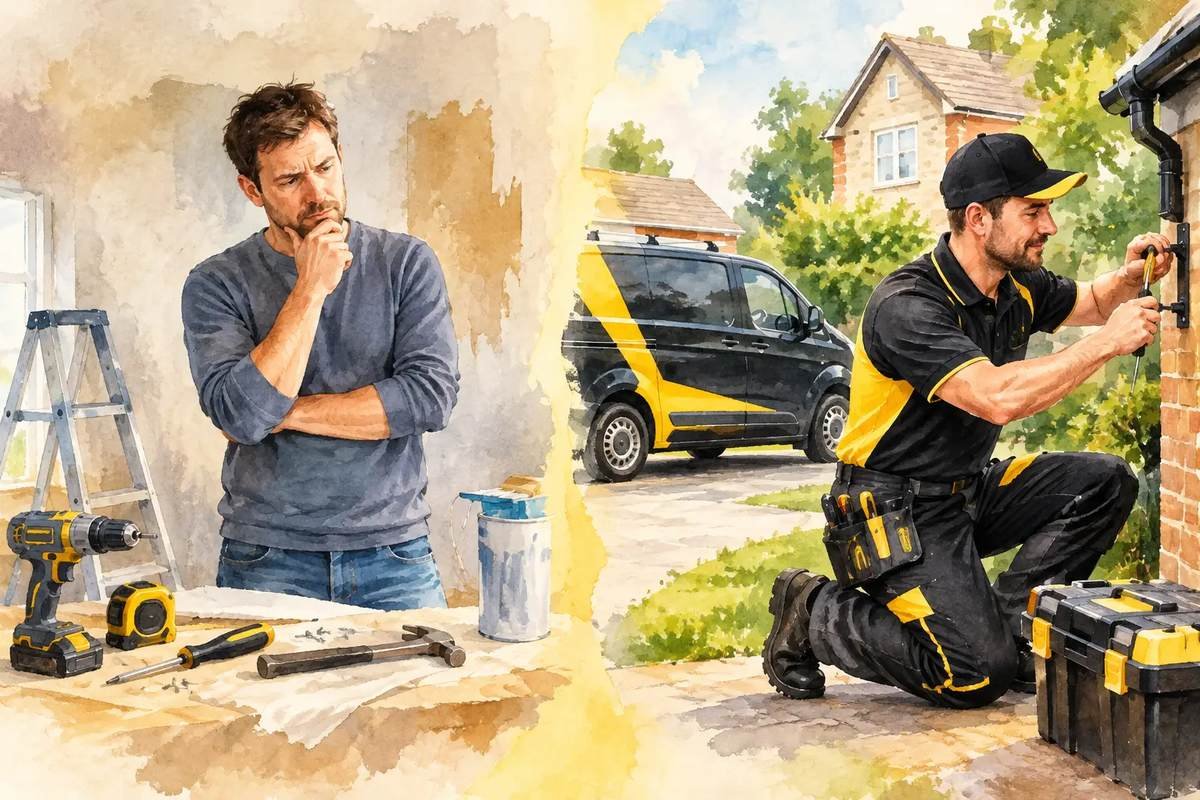
That loose cupboard door, stiff window handle and hallway that needs painting can look like a straightforward Saturday. Sometimes they are. But DIY versus an insured handyman is rarely just a question of whether you own a drill. It is a decision about your time, confidence, the condition of your home and who carries the risk if a small job becomes a bigger one.
There is no prize for calling someone in too early, and no shame in deciding a job is beyond your comfort zone. The sensible choice is the one that leaves your home safe, tidy and properly finished - without turning a short task into a fortnight of frustration.
DIY versus an insured handyman: the real difference
DIY can be a good answer when the task is low-risk, you understand the materials involved and you have enough time to do it properly. Replacing a worn seal, touching up a small patch of paint or assembling a simple item may be satisfying and economical. You are in control of the pace, and you learn something along the way.
The picture changes when accuracy, safe access, fixing into unknown walls or several connected jobs are involved. A television bracket, for example, is not only about getting the screen level. The wall type, fixings, cable route, weight and final position all matter. The same applies to a leaking fitting beneath a sink, a door that will not latch, damaged fencing or a bathroom tile repair where moisture may already have found its way behind the surface.
An insured handyman brings practical experience, appropriate tools and an accountable person into the equation. Insurance is not a magic badge that makes every outcome automatically covered. It does, however, show that the person takes professional responsibility seriously and has arranged protection for the work they carry out. It is reasonable to ask what cover they hold and whether your particular job falls within their normal scope.
Cost is more than the receipt at the builders' merchant
DIY appears cheaper because the labour cost is your own time. That can be true if you already have the right tools, know what to buy and complete the job first time. Yet the actual cost can rise quickly with incorrect fixings, duplicate purchases, damaged materials or a repair that has to be put right later.
Then there is the cost nobody writes down. A three-hour job can consume a full day when you add measuring, travelling to collect supplies, watching tutorials, setting up, cleaning down and making a second trip for the part you did not know you needed. For a busy household or a landlord between tenancies, that lost time has a value.
A professional visit is not always the cheapest route for one tiny task. It often becomes better value when you have a list. A loose curtain pole, two doors needing adjustment, a lock change and a few areas of painting are easier to organise with one dependable person than with four separate jobs hanging over your weekend. This is where a clearly booked labour slot can make practical sense: the work is planned, the list is prioritised and anything that needs more time can be identified honestly.
The risk is not always obvious at the start
Most DIY mishaps do not begin with recklessness. They begin with a reasonable assumption: “This wall will take the same fixing as the last one,” or “That damp patch is probably just condensation.” Homes, particularly older properties, often have surprises behind paint, tiles, plasterboard and flooring.
An experienced handyman cannot see through walls either. The difference is knowing when to pause, investigate and avoid guessing. That judgement protects the property as much as the repair itself. A rushed repair can hide a problem rather than solve it, especially around water damage, window mechanisms and worn bathroom sealant.
Working at height deserves the same clear thinking. Reaching an awkward exterior fitting from an unsuitable ladder or balancing on furniture indoors is not a sensible money-saving exercise. If access is not safe, the right answer may be to change the plan or bring in the appropriate specialist. A trustworthy handyman should be prepared to say so rather than force a job through.
When DIY is the sensible choice
You do not need to outsource every mark, squeak or loose screw. DIY is usually a sensible option when the job is cosmetic, easily reversible and does not affect the home’s security, water resistance or safe use. It can also suit you if you genuinely enjoy the work and can give it your full attention.
Before starting, be honest about three things: whether you know the likely cause of the issue, whether you have the right equipment and whether you will be content with the finish. A temporary repair is sometimes perfectly acceptable, but call it temporary. Do not rely on it as a long-term answer simply because it took effort.
It also helps to stop before the point of damage. If a screw keeps spinning, a fitting will not sit flush or a job reveals rot, damp or a damaged surface, continuing by force usually makes the eventual repair more involved. Taking a photograph, measuring the area and getting advice at that point is often the wisest move.
When an insured handyman earns their keep
Professional help is worth considering when a job affects the security, function or finish of your home, or when it needs more than one practical skill. A poorly fitted internal door may not close correctly. A damaged window mechanism can compromise security. A repair near water needs care because a small leak may affect cupboards, flooring or finishes before it becomes visible.
It is also the better route if you are preparing a property for tenants, returning a home to a decent standard after wear and tear, or trying to get on top of a maintenance list that has grown quietly over months. The benefit is not just the physical work. It is having one person assess the order of jobs, bring a methodical approach and leave the place tidy.
For Swindon homeowners and landlords, a local named operator can make that arrangement more straightforward. With Handyman Plus Van, Ian offers bookable three-hour and six-hour slots for suitable domestic work, giving customers a practical way to group smaller tasks rather than chasing several appointments. Message me free on WhatsApp, or book a paid 20-minute video call if you'd rather talk it through. Some lists suit one session; others typically need several.
Ask better questions before you book
The phrase “insured handyman” should prompt a useful conversation, not replace one. Describe the job clearly, including what has happened so far, the location, access and any materials you already have. Photos are often helpful where they can show the issue without guesswork.
Ask whether the task is within the handyman’s usual work, what preparation is needed from you, and whether the likely timescale suits a booked slot. If the work could uncover further damage, ask how that will be handled. Clear answers prevent awkward assumptions on the day.
It is also worth agreeing what “finished” means. Does it include supplying materials, matching paint, disposing of packaging you have created, or simply completing the repair? Different jobs need different arrangements. Straightforward expectations are kinder to everyone and usually lead to a better result.
Make the choice based on the job, not pride
DIY and professional help are not opposing teams. Plenty of capable homeowners paint a room themselves and sensibly call someone in for the awkward carpentry, secure wall fixing or repair that needs a trained eye. Equally, a good handyman will not make a simple job sound complicated just to win work.
The best test is simple: if you can do the work safely, have the time and understand what a good result requires, DIY may be right for you. If the task carries a risk of damage, needs reliable finishing or is one item on a longer list, an insured professional can be the calmer choice.
Your home does not need drama or a heroic weekend rescue. It needs sensible decisions, clear boundaries and the right pair of hands for the job.
Want to book?
I'm a one-man handyman service in Swindon — insured, DBS checked, and rated 4.9 on Google. 3-hour sessions cover Swindon (town); full days cover about 30 minutes around Swindon.
Book a session, or message me free on WhatsApp on 07729 689420. If you'd rather talk it through first, you can book a paid 20-minute video call.
