
A television can look smart on the wall, free up useful floor space and stop a low unit becoming a magnet for dust and tangled leads. But the best TV mounting options are not simply about choosing the bracket with the most movement. Your wall type, room layout, viewing position and the TV’s weight all matter — and getting one of those wrong can turn a tidy upgrade into an expensive problem.
For most homes, the right answer is a properly fitted bracket matched to both the television and the wall behind it. The aim is simple: a secure screen at a comfortable height, with cables considered before the drill comes out. No drama, no guesswork, just a sensible installation that works in the room you actually have.
Best TV mounting options for different rooms
Fixed wall brackets
A fixed bracket holds the television close to the wall. It is usually the neatest option, and it suits a lounge or bedroom where you will nearly always watch from the same place.
Because there is very little gap behind the TV, fixed brackets give a clean, low-profile finish. They are particularly good where the screen is being mounted at eye level and there is no need to reach connections regularly. The trade-off is access. If you need to change an HDMI lead or use ports at the back of the television, it can be awkward once everything is in place.
A fixed mount also gives you no adjustment if glare becomes a problem. Before choosing one, sit where you normally watch and check for reflections from windows, lamps and patio doors at different times of day.
Tilting brackets
A tilting bracket allows the bottom of the TV to angle slightly away from the wall. This is often the practical choice when a screen needs to sit higher than ideal, such as above a tall cabinet or in a bedroom where you watch from the bed.
That small tilt can make a real difference to picture comfort and reduce reflections from ceiling lights. It also creates a little more room for cable connections. The television still sits fairly close to the wall, so it keeps a tidy appearance without the bulk of a full-motion arm.
There is a limit, though. Tilting a TV does not make an overly high mounting position comfortable. If you are craning your neck to watch it, the bracket is not the real issue. A lower position or a different wall may be the better call.
Full-motion and cantilever brackets
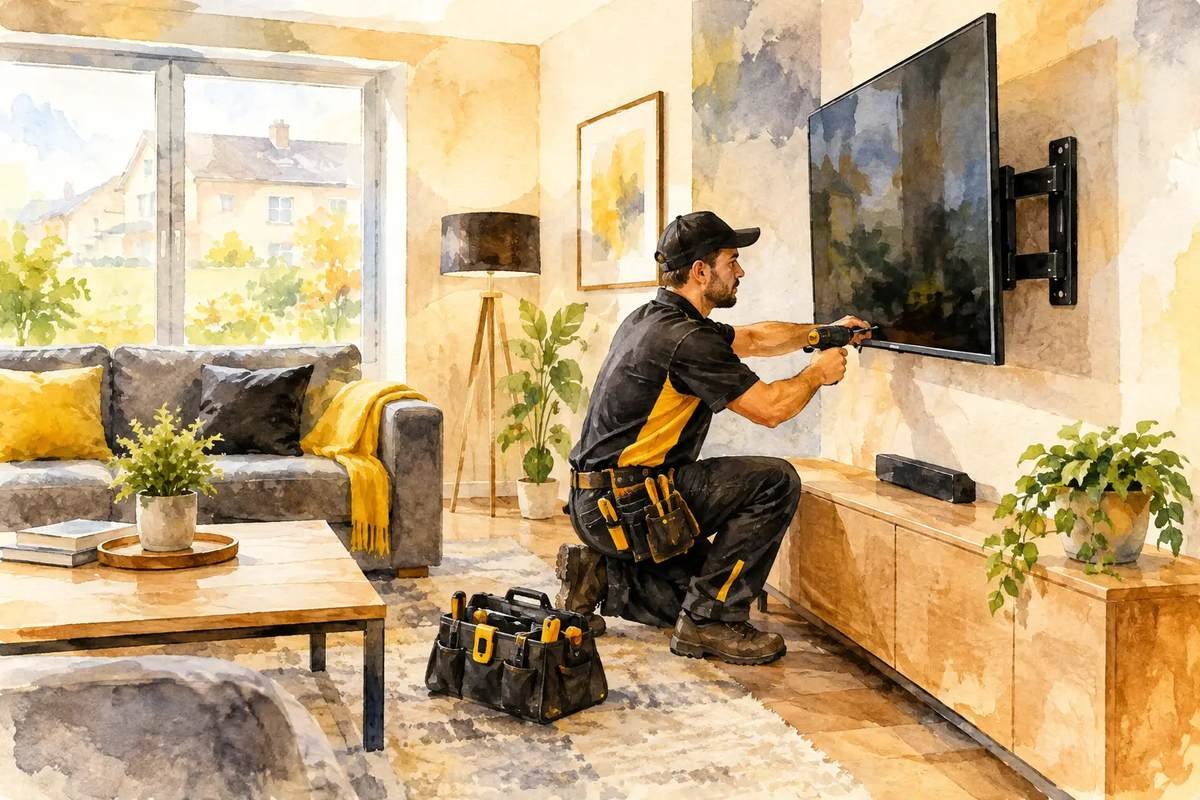
A full-motion bracket, sometimes called an articulated or cantilever bracket, lets the television pull away from the wall, swivel left or right and tilt. It is the most flexible of the common wall-mounted options.
This works well in an open-plan room, a kitchen-diner or a lounge where people watch from more than one seating area. It can also be useful for a corner position, provided there is enough clear space for the screen to move without catching a wall, cupboard or door.
The compromise is that these brackets place more leverage on the wall fixings, especially when the arm is extended. They need careful selection and secure fitting into a suitable structure. They also sit further from the wall than a fixed bracket and may leave more cables visible when the screen is pulled forward. Flexibility is useful, but only if it solves a genuine viewing problem.
Ceiling and specialised mounts
Ceiling mounts and drop-down mechanisms are sometimes useful in awkward rooms, but they are not a standard answer for every home. They rely on the ceiling structure being suitable, and they must be planned around head clearance, opening doors and safe access for installation.
Likewise, some screens can be mounted in a recess, on a chimney breast or above fitted furniture. These can look excellent, but the surface behind the plaster needs checking first. A wall that sounds solid is not automatically a safe fixing point, particularly in older properties or where there may be a void behind the finish.
The wall matters as much as the bracket
A TV bracket is only as secure as the surface it is fixed to. In many homes, a solid brick or block wall is straightforward when the correct fixings are used. Stud walls need a more careful approach. The bracket may need to be fixed into timber studs, with the television size and bracket design taken into account.
Plasterboard and dot-and-dab walls need particular care. Fixing only into the plasterboard is not a sensible shortcut for a heavy screen. Where the wall needs it, I reinforce with plywood so the bracket has a sound backing rather than relying on board alone. The same care applies to damaged plaster, loose masonry or walls that have previously had poor fixings pulled from them.
Before mounting, check for likely pipe and cable routes, assess the wall construction and confirm that there is enough sound material for the chosen fixing points. This is the less glamorous part of the job, but it is what keeps the television where it belongs. I do not do electrical work — any new sockets or fixed wiring need a qualified electrician.
Choose the bracket by specification, not by screen size alone
Television size is a useful starting point, but it is not the full story. Look at the TV’s weight without its stand, the VESA fixing pattern on the back and the bracket manufacturer’s stated weight capacity. A 55-inch television can weigh very differently from another 55-inch model.
The VESA pattern is the arrangement of mounting holes on the rear of the screen. It is normally given in millimetres, such as 200 x 200 or 400 x 300. A compatible bracket must support that pattern as well as the TV’s weight. Check the instructions for any spacers, bolts or washers required, too. Using a bolt that is too long can damage the set; one that is too short may not provide enough thread engagement.
Avoid treating the stated maximum load as a target. A sensible margin is always better, particularly with full-motion brackets where the arm increases the forces acting on the fixings.
Get the height right before drilling
Most people are happiest when the centre of the television is around seated eye level. In a typical lounge, that often puts the screen lower than expected. The temptation is to mount it high to make a feature wall feel balanced, but comfort should come first if the TV is used regularly.
Mark the proposed position with masking tape or cut-out paper before committing. Sit on the sofa, not just stand in the room. Check the view from the chair everyone uses, and think about whether a coffee table, fireplace, radiator or cabinet affects the layout.
If the television is going above a fireplace, take extra care with both height and heat. A screen placed too high can be uncomfortable to watch, while heat rising from an active fireplace may not be suitable for the TV. Manufacturer guidance should always be checked for clearances and operating conditions.
Plan cables before the television goes up
A well-mounted television can still look unfinished if leads are left dangling. Work out what needs to connect before choosing the final position: aerial cable, internet connection, games console, soundbar, streaming device and power lead all take space.
Sometimes a simple cable cover is the cleanest, least disruptive answer. In other situations, furniture can hide most of the run. Do not assume every lead will reach, particularly with a full-motion bracket. Cables need enough slack for the screen to move without being pulled tight, but not so much that they become a visible tangle.
It also helps to think ahead. If you may add a soundbar, replace a console or change broadband equipment later, leave sensible access rather than trapping every connection behind a fixed screen.
When a professional fitting is worth it
Mounting a small television on a clear solid wall can look like a quick DIY task. The risks rise when the screen is large, the wall construction is uncertain, the position is high, or the bracket has moving arms. There is also the practical issue of handling the television safely while lining it up accurately — I will not lift over 15 kg alone.
For homeowners and landlords, a professional fitting can remove the uncertainty around bracket choice, fixings, positioning and a tidy finish. If you are in Swindon and have a television to mount alongside other jobs, Handyman Plus Van can help you plan the work around a bookable labour slot. Message me free on WhatsApp, or book a paid 20-minute video call if you'd rather talk it through — a few photos beforehand can often confirm whether the job is suitable and what needs to be ready on the day.
The best choice is the one that suits your wall, viewing habits and room, not necessarily the bracket with the longest feature list. Take a little time to measure, check the structure and picture how the space will be used. A securely mounted TV should feel like part of the room, not something you have to worry about every time someone walks past it.
Want a TV mounted properly?
I'm a one-man service, insured and DBS checked, and rated 4.9 on Google. 3-hour sessions cover Swindon (town); full days cover about 30 minutes around Swindon. I'll do my best to get through your list in the time booked.
Book a session, or message me free on WhatsApp on 07729 689420. If you'd rather talk it through first, you can book a paid 20-minute video call.
