
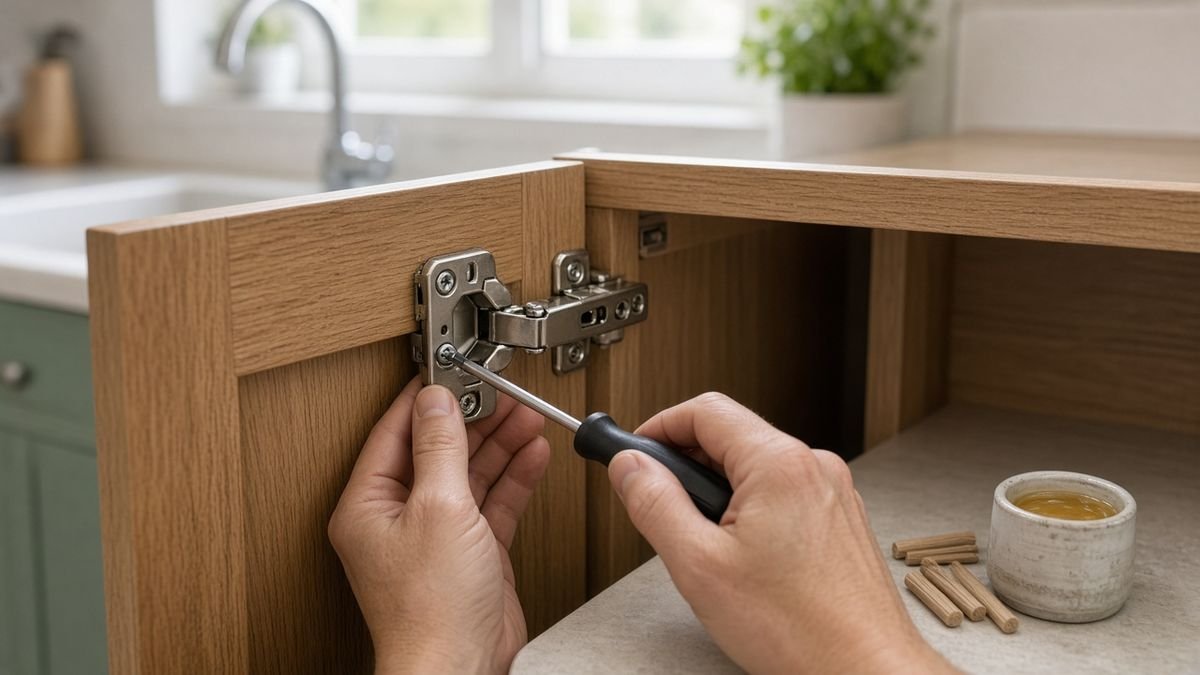
A kitchen cupboard door that drops, clashes with its neighbour or won't close flush is one of the most common small jobs I see around Swindon. Most people assume the kitchen is worn out. Usually it isn't. More often than not, the hinge just needs adjusting, or a stripped screw hole needs a proper repair.
Here's how to tell which, and how to sort it yourself.
Know your hinge
Most fitted kitchens use concealed hinges. You can't see them from the front. Inside, there's a round cup set into the back of the door, a hinge arm, and a mounting plate screwed to the side of the cabinet.
Concealed hinges are designed to be adjusted, so a door that's out of line can usually be brought back without new parts. Makes differ, so if yours looks unfamiliar, check the manufacturer's instructions first.
Tools
- A hand screwdriver, usually Pozidriv (cross-head)
- A torch
- Wood glue and a few small wooden dowels or matchsticks, if a screw hole has stripped
Avoid using a drill driver on the adjustment screws. It's very easy to strip the heads.
Step by step
- Tighten the fixing screws. Check the screws holding the mounting plate to the cabinet and the cup to the door. If any are loose, tighten them first. You can't adjust a hinge that's moving about.
- Adjust side to side. On most hinges, the screw on the arm nearest the door moves the door left or right. Use it to even up the gaps and stop doors catching each other. Quarter turns are plenty.
- Adjust depth. The screw further back on the arm usually moves the door in or out, so it sits flush with the cabinet. On some designs this screw also holds the arm on, so loosen it carefully.
- Adjust height. Height is usually set at the mounting plate. Slacken its screws (or turn the cam, if it has one), move the door up or down, then re-tighten. Adjust both hinges on the door evenly.
- Check and repeat. Close the door after each small change. Most doors line up after a few rounds.
Stripped screw holes
If a screw keeps turning without biting, the chipboard around it has broken down. A larger screw rarely holds for long. A better repair is to glue wooden dowel or matchsticks into the hole, let the glue set fully, trim flush and re-drive the screw. Where the cup hole in the door has torn out, a hinge repair plate can often save the door.
If the cabinet is soft or swollen, it has usually been wet, often from a slow leak under the sink. Find and fix the leak before repairing the hinge, or the problem will come back.
When it's not the hinge
- A warped door won't sit flat however you set the hinges.
- A broken hinge (cracked arm or a soft-close that's stopped working) is best replaced with a matching hinge.
- A sagging carcass with failed joints may need more than an adjustment.
Need a hand?
Adjusting a full kitchen of doors is a tidy job to add to a booked session. I work in 3-hour or full-day sessions in Swindon, and I'll do my best to get your list done in the time booked. See my kitchen services, book a session, or message me on WhatsApp on 07729 689420.
For a lighter take on the same job, read my blog post: Kitchen cupboard door won't close properly?
